
Step-by-Step Process That Actually Works in 2026
Hafsa Akter - 23 July, 2026
To do a content gap analysis with AI, compare your website’s keyword rankings against 3–5 competitors using an SEO tool like Ahrefs or Semrush. Then use AI to cluster the missing keywords by topic and intent, score each cluster by search volume, keyword difficulty, and business fit, and turn the highest-scoring clusters into new or updated content.
This turns a process that used to take days of manual spreadsheet work into a few focused hours. It’s the fastest way to find content opportunities your competitors are already capturing.
A content gap analysis identifies the topics, keywords, and questions your competitors rank for that your website hasn’t covered yet. Doing it with AI doesn’t change what you’re looking for. It changes how fast and how thoroughly you can find it, since AI can process far more data and spot patterns a manual review would miss.
This article walks through the complete, step-by-step process for running an AI-driven content gap analysis in 2026 — from data collection to prioritization to execution — along with a reusable framework you can apply to any B2B content strategy.
What Is a Content Gap Analysis?
At its core, a content gap analysis is just a comparison. You take your existing content and rankings, line them up against a competitor’s, and see what they’re capturing that you’re not. The output is a list — hopefully a prioritized one — of content opportunities sitting right there for the taking.
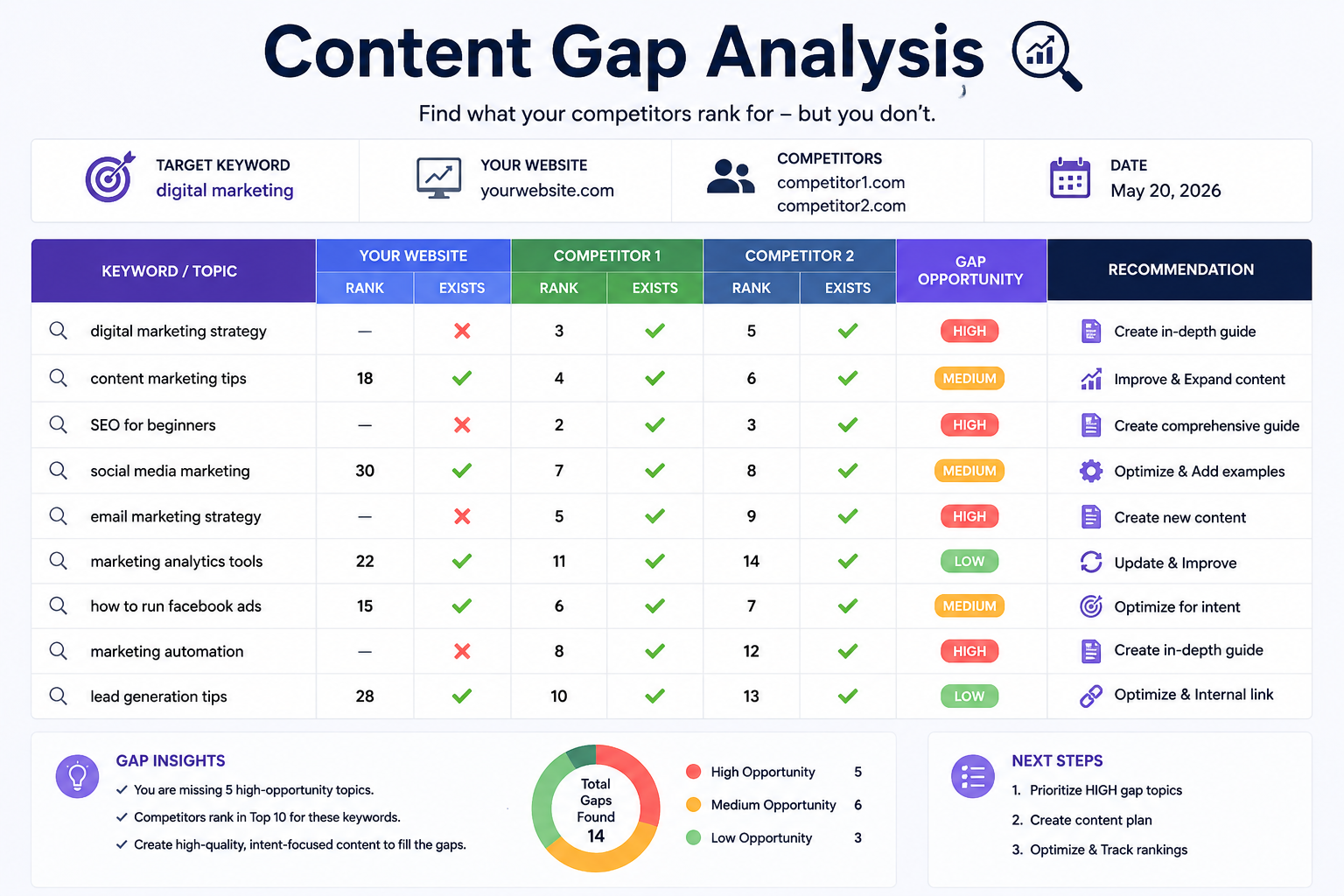
The old-school way of doing this involved manually poking through competitor URLs, pulling keyword exports into a spreadsheet, and eyeballing the overlap. It worked, but it was slow, and it was easy to miss things.
An AI-driven version handles most of that grunt work for you. It pulls the ranking data, groups related keywords together, and can even suggest angles for the content itself — which frees your team up to actually write instead of babysitting spreadsheets all week.
Why AI Changes the Content Gap Analysis Process
Manual content gap analysis has always had the same three problems. It’s slow. It doesn’t scale past a few hundred keywords before your eyes glaze over. And it’s biased — an analyst working through a long list will naturally gravitate toward keywords that “feel” important, while smaller long-tail opportunities quietly sit buried near the bottom, never looked at.
AI fixes all three at once, and it’s worth breaking down exactly how:
- Speed. A week of cross-referencing competitor keywords can now realistically happen in an afternoon.
- Scale. AI can work through thousands of keyword and URL data points at once — something that’s simply not realistic for a person to do by hand.
- Pattern detection. This is the one people underestimate. AI is genuinely good at spotting that “content gap analysis checklist,” “content gap analysis template,” and “content gap analysis steps” are really the same topic wearing different outfits, even though they’re technically separate search queries.
The end result isn’t just a faster process — it’s a more complete one. You’re not relying on whatever happens to catch your eye anymore. You’re working from an actual map of the competitive landscape.
Step-by-Step Process
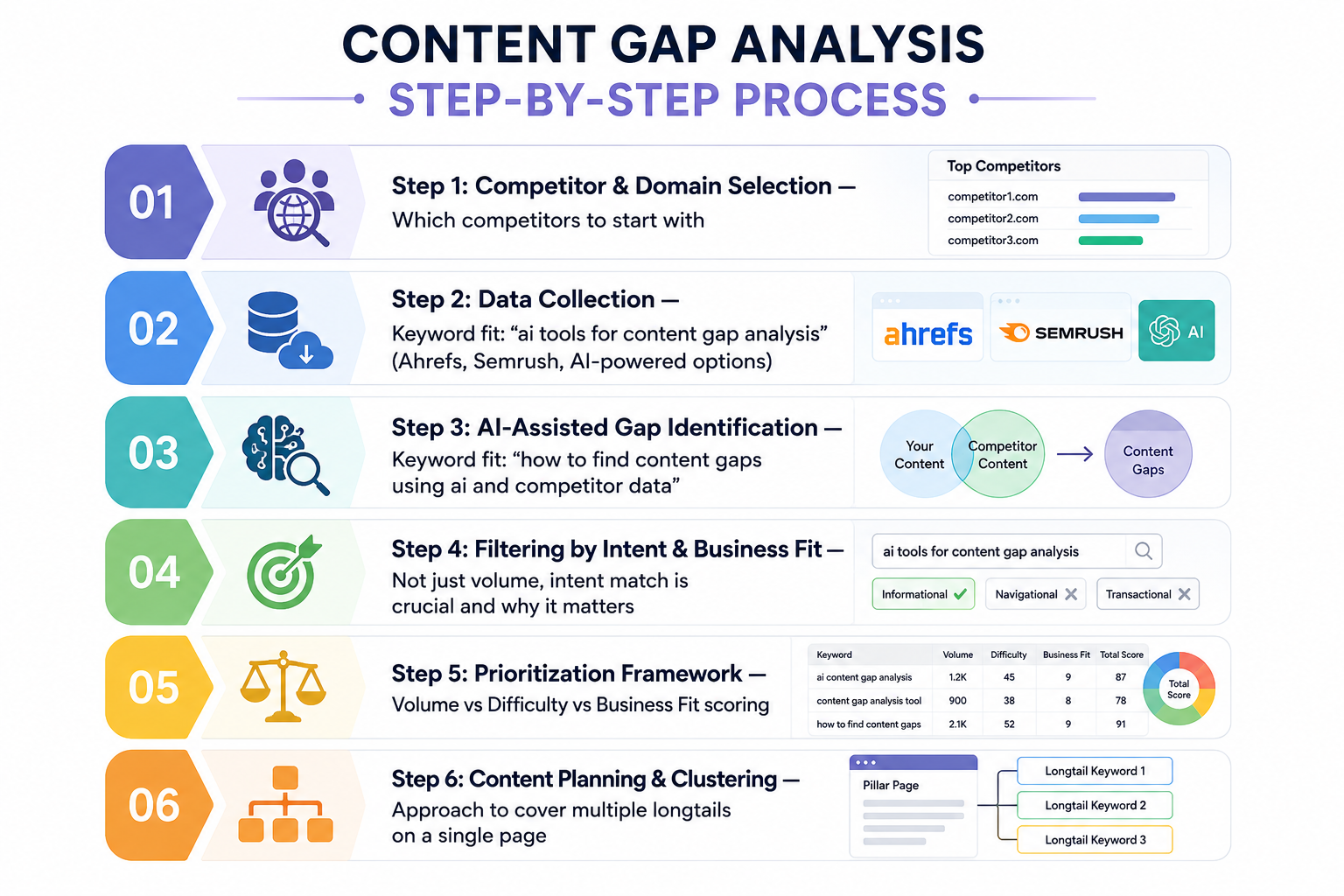
Step 1: Competitor & Domain Selection
Before you touch any data, figure out who you’re actually comparing yourself against. This step gets skipped more often than it should, but it matters a lot.
Pick a competitor way bigger than you, and you’ll end up with hundreds of gaps you have no realistic shot at closing anytime soon. Pick one too similar in size to your own site, and you might not find much worth chasing at all.
A decent starting mix looks like this:
- 2–3 direct competitors, roughly your size, roughly your audience
- 1 aspirational competitor — bigger, but still in your niche
- 1 competitor that happens to rank well for a specific sub-topic you care about
Step 2: Data Collection
This is where the AI tools for content gap analysis actually earn their keep. Plug your domain and your competitors’ domains into something like Ahrefs or Semrush, and within minutes you’ll have a list of keywords they rank for that you don’t.
Don’t filter anything yet — just collect. Pull the keyword, the search volume, the keyword difficulty, the ranking URL, and the search intent if the tool gives it to you. Depending on your niche, this raw export can easily run into the thousands.
Step 3: AI-Assisted Gap Identification
Once you’ve got the raw data, this is where finding content gaps using AI and competitor data really shows its value. Instead of scrolling through a spreadsheet for an hour, feed the list into an AI tool and have it:
- Group keywords into clusters based on what they actually mean, not just how they’re worded
- Flag the ones with a good ratio of search volume to difficulty
- Point out which gaps could be closed by updating an existing page versus which genuinely need something new
Here’s where AI pulls ahead of manual work in a real way — it can tell you that “content gap analysis framework,” “content gap analysis process,” and “content gap analysis steps” are all one topic, saving you from accidentally writing three thin, competing articles about the same thing.
Step 4: Filtering by Intent & Business Fit
Not every gap deserves a spot on your content calendar. A keyword pulling in thousands of searches a month means nothing if the people typing it have zero intention of ever buying from you.
So filter what you’ve got using two simple questions:
- What’s the searcher actually trying to do? Are they researching, comparing, or ready to buy right now?
- Does this even fit your business? Great volume and low difficulty don’t matter much if the topic has nothing to do with what you sell.
This is the step teams tend to skip when they get excited about a big list of “easy” keywords. Skip it, and you end up with traffic that never turns into anything.
Step 5: Prioritization Framework
Once your list is filtered, score whatever’s left across three things:
- Search volume — how many people are actually typing this in
- Keyword difficulty — how hard it’ll realistically be to rank
- Business fit — how closely it lines up with what you actually offer
Rate each factor on a simple 1–3 scale, multiply them together, and sort the results from highest to lowest. What lands at the top isn’t necessarily the biggest keyword on your list — it’s the one with the best return once you weigh everything together.
Step 6: Content Planning & Clustering
Now turn that prioritized list into something you can actually act on. Resist the urge to write one article per keyword — instead, group related long-tail variations into a single, well-built page. A good article can realistically rank for dozens of long-tail phrases at once, as long as it genuinely answers the underlying question.
While you’re at it, decide whether each gap needs a brand-new page or whether an existing one just needs to be expanded. More often than people expect, updating something that already exists closes the gap faster than starting from scratch.
A Simple Content Gap Analysis Framework for B2B Marketing
If you want something repeatable for a B2B content gap analysis framework, here’s the condensed version of everything above, boiled down to five steps you can run every quarter:
- Audit: Pull ranking data for your domain against 3–5 competitors
- Cluster: Let AI group the keyword gaps into topics by intent
- Score: Rate each cluster on volume, difficulty, and business fit
- Plan: Send each high-priority cluster to either a new page or an existing update
- Review: Come back and do it all again in a few months — the landscape shifts more than people think
Content Gap Analysis vs Keyword Gap Analysis
People throw these two terms around like they mean the same thing, but they don’t quite line up.
Keyword gap analysis is the narrower of the two — it’s purely about which specific keywords your competitors rank for that you don’t. It’s a data-level comparison, nothing more.
Content gap analysis zooms out further. It looks at whole topics, content formats, and how deep the coverage actually goes, not just individual keywords. It’s less “what keywords are we missing” and more “what entire subject areas haven’t we touched at all.”
In practice, one feeds into the other. You start with the keyword data, then step back to see what bigger topical gaps that data is actually pointing to.
Quick Content Gap Analysis Checklist for Marketers
Before you move into actual content production, run through this:
- Selected 3–5 relevant competitors (not just the biggest names in your space)
- Exported full keyword gap data, not just the top 20–30 results
- Used AI to cluster keywords into topic groups instead of treating each one as a separate article
- Filtered out keywords with no genuine business fit
- Scored remaining gaps on volume, difficulty, and business fit
- Checked whether each gap can be closed via an existing page update instead of new content
- Assigned a content type (guide, comparison, checklist, FAQ page) to each priority gap
- Set a recurring schedule (quarterly is a good default) to repeat the analysis
Common Mistakes to Avoid
- Chasing volume for its own sake. A keyword with 5,000 searches a month is worthless if nobody searching for it is close to becoming a customer.
- Write a separate article for every keyword. This just creates thin, overlapping pages that end up competing with each other instead of with your actual competitors.
- Ignoring intent. Skip this, and you’ll build a content plan that pulls in visitors who never convert.
- Defaulting to new pages. Sometimes expanding what’s already there gets you there faster than starting over.
- Treating this as a one-and-done project. Rankings shift, competitors publish new content, and search behaviour changes — a gap analysis you never revisit goes stale fast.
Conclusion
None of this replaces judgment — AI just clears out the grunt work so your team can spend time on the decisions that actually need a human: which gaps matter, what to prioritize, and how to build something that genuinely helps whoever’s searching.
Run through the six steps, lean on the B2B framework if that’s your world, and check back in every quarter or so. That’s really all it takes to keep your content strategy pointed at where the actual opportunity is.
FAQ
Q: How is an AI-driven content gap analysis different from a manual one?
A: The core process is the same — comparing your rankings against competitors’. But AI handles the data processing, clustering, and pattern recognition at a scale manual analysis can’t match, reducing the chance of missing valuable long-tail opportunities buried in large datasets.
Q: What tools are commonly used for AI-driven content gap analysis?
A: Ahrefs and Semrush are the most widely used platforms for pulling competitor keyword data, and both now include AI-assisted features for clustering and prioritization. Many teams also feed exported keyword data into general-purpose AI tools to assist with clustering and content planning.
Q: How often should a content gap analysis be repeated?
A: At minimum, once per quarter. Search behavior, competitor content, and ranking algorithms all shift over time, so a gap analysis done once and never revisited will become outdated within a few months.
Q: Should I always create new content to fill a gap, or can I update existing pages?
A: Whenever possible, check if an existing page can be expanded to cover the gap before creating a new one. Updating and expanding underperforming content is often faster and more effective than publishing from scratch, and it avoids creating multiple thin pages competing for the same topic.
Q: What’s the difference between content gap analysis and keyword gap analysis?
A: Keyword gap analysis is a narrower, data-level comparison of specific keywords you’re missing. Content gap analysis is broader — it looks at entire topics and depth of coverage, using keyword-level data as one of several inputs.
Q: Is search volume the most important factor when prioritizing gaps?
A: No. Search volume matters, but business fit is often the most underweighted factor. A high-volume keyword with no alignment to what you actually offer will bring traffic that rarely converts. Prioritize gaps that score well across volume, difficulty, and business fit together.