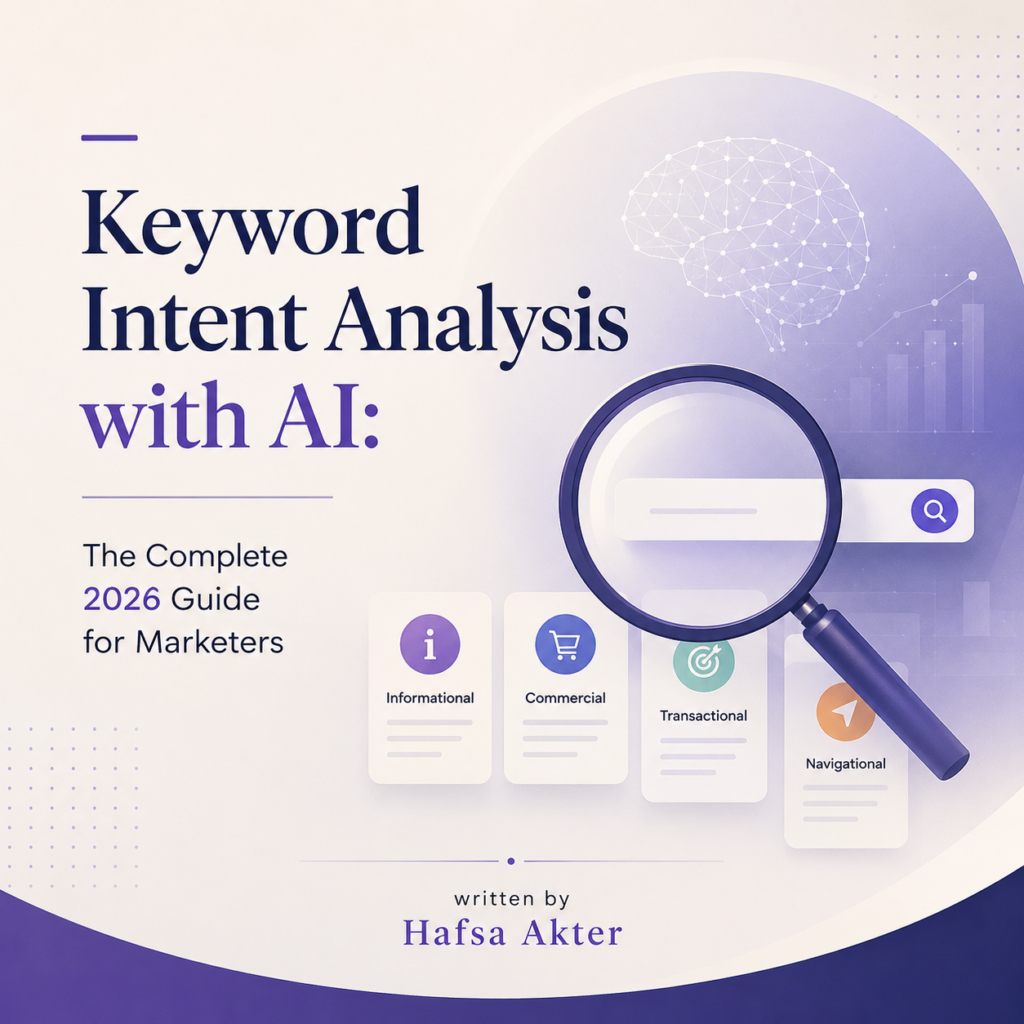
The Complete 2026 Guide for Marketers
Why Your Ranked Content Isn’t Converting
Hafsa Akter - 30 July, 2026
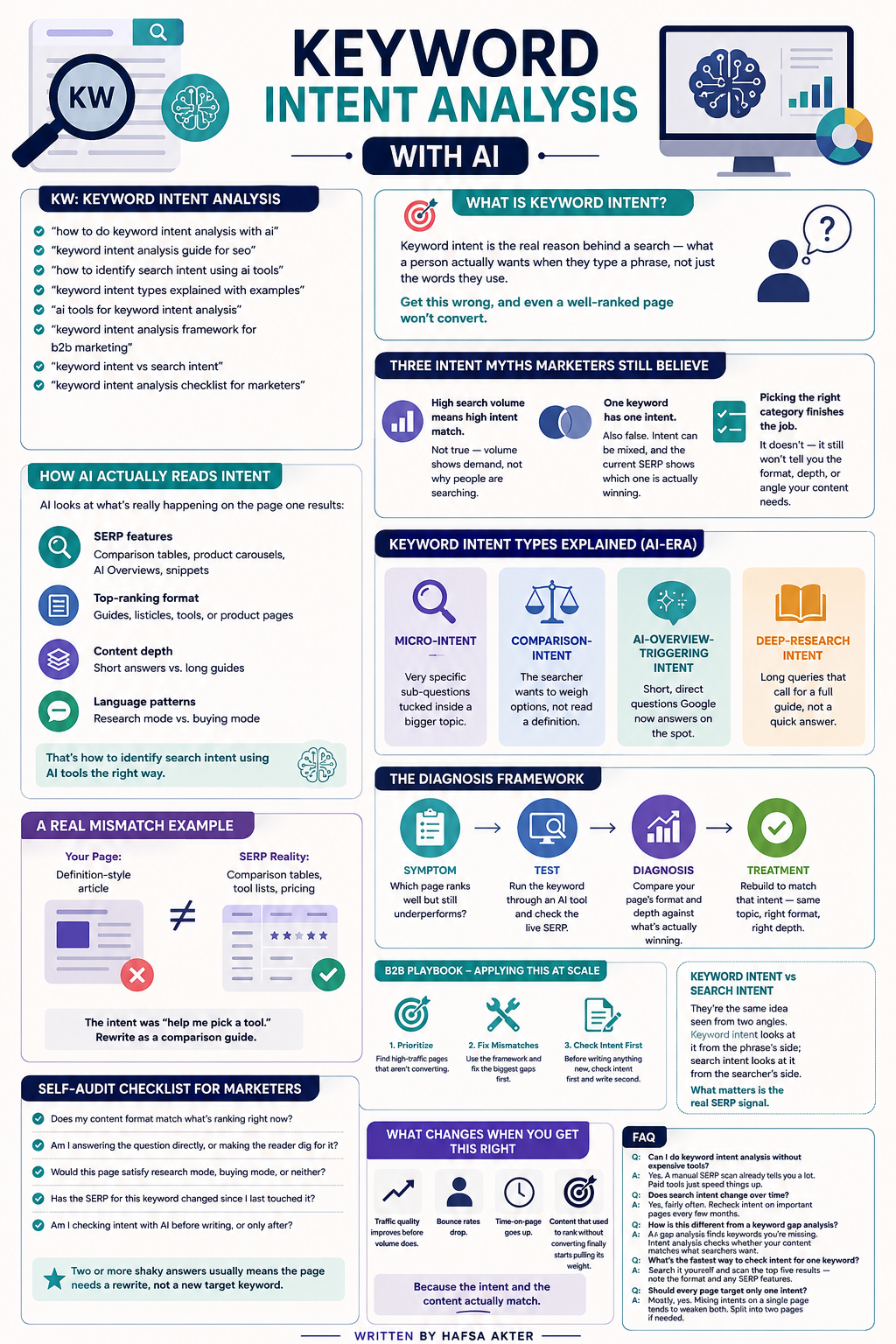
Keyword intent is the real reason behind a search — what a person actually wants when they type a phrase, not just the words they use. Get this wrong, and even a well-ranked page won’t convert.
You picked a good keyword. You wrote a solid page. It ranks on page one. Still — no leads, no sales.
That’s rarely a keyword problem. It’s a keyword intent problem — the page ranks for the right words but misses what the searcher actually wanted. This keyword intent analysis guide walks through how to fix that with AI, not by chasing more keywords, but by actually understanding the ones you already have.
The Old Way Was Broken
For years, intent analysis just meant sorting keywords into four boxes: informational, navigational, commercial, transactional. Simple, but often wrong in practice.
A keyword doesn’t carry one fixed intent forever. Search behavior shifts, results shift with it, and manual sorting just can’t keep pace. This is exactly why more marketers are turning to AI tools for keyword intent analysis instead.
Three Intent Myths Marketers Still Believe
- High search volume means high intent match. Not true — volume shows demand, not why people are searching.
- One keyword has one intent. Also false. Intent can be mixed, and the current SERP shows which one is actually winning.
- Picking the right category finishes the job. It doesn’t — it still won’t tell you the format, depth, or angle your content needs.
How AI Actually Reads Intent
Instead of slapping on a label, AI looks at what’s really happening on the page one results:
- SERP features — comparison tables, product carousels, AI Overviews, snippets
- Top-ranking format — guides, listicles, tools, or product pages
- Content depth — short answers vs. long guides
- Language patterns — research mode vs. buying mode
That’s how to identify search intent using AI tools the right way — reading what Google is already showing you, instead of guessing a category and hoping it holds.
The Diagnosis Framework
Think of it less like a checklist and more like troubleshooting:
- Symptom: Which page ranks well but still underperforms?
- Test: Run the keyword through an AI tool and check the live SERP.
- Diagnosis: Compare your page’s format and depth against what’s actually winning.
- Treatment: Rebuild to match that intent — same topic, right format, right depth.
Keyword Intent Types Explained (Reimagined for AI-Era Search)
The old four categories still exist, but they’re not enough anymore. It helps to think in sharper terms:
- Micro-intent — very specific sub-questions tucked inside a bigger topic
- Comparison-intent — the searcher wants to weigh options, not read a definition
- AI-Overview-triggering intent — short, direct questions Google now answers on the spot
- Deep-research intent — long queries that call for a full guide, not a quick answer
A Real Mismatch Example
Take a page ranking for “keyword intent analysis tools” that reads like a plain definition post. Check the actual SERP, though, and it’s full of comparison tables — tool A vs. tool B, pricing breakdowns, feature lists.
The intent here was never “explain the concept.” It was “help me pick a tool.” Rewrite the page as a comparison guide, and rankings usually hold steady while time-on-page and conversions climb. Same keyword, different format, very different outcome.
B2B Playbook — Applying This at Scale
For B2B teams, a keyword intent analysis framework for B2B marketing works best as a running habit, not a one-off project.
Start with high-traffic pages that aren’t converting and run each one through the diagnosis framework above. Fix the biggest mismatches first — usually the pages sitting closest to a buying decision. Then, before writing anything new, check intent first and write second.
Keyword Intent vs Search Intent — Solved in One Line
They’re the same idea seen from two angles. Keyword intent looks at it from the phrase’s side; search intent looks at it from the searcher’s side. Most marketers use the terms interchangeably, and honestly, that’s fine — what actually matters is checking the real SERP signal, not arguing over the label.
Self-Audit Checklist for Marketers
Run through these before deciding a page needs a new keyword instead of a rewrite:
- Does my content format match what’s ranking right now?
- Am I answering the question directly, or making the reader dig for it?
- Would this page satisfy research mode, buying mode, or neither?
- Has the SERP for this keyword changed since I last touched it?
- Am I checking intent with AI before writing, or only after?
Two or more shaky answers usually means the page needs a rewrite, not a new target keyword.
What Changes When You Get This Right
Traffic quality tends to improve before volume does. Bounce rates drop, time-on-page goes up, and content that used to rank without converting finally starts pulling its weight — simply because the intent and the content actually match now.
FAQ
Q: Can I do keyword intent analysis without expensive tools? A: Yes. A manual SERP scan already tells you a lot. Paid tools just speed things up — the core method still works with free tools.
Q: Does search intent change over time? A: Yes, fairly often. Google updates and shifting user behavior change what ranks, so it’s worth rechecking intent on important pages every few months.
Q: How is this different from a keyword gap analysis? A: A gap analysis finds keywords you’re missing. Intent analysis checks whether the content you already have actually matches what searchers want.
Q: What’s the fastest way to check intent for one keyword? A: Search it yourself and scan the top five results — note the format and any SERP features like comparison boxes or AI Overviews.
Q: Should every page target only one intent? A: Mostly, yes. Mixing intents on a single page tends to weaken both. If a topic genuinely serves two intents well, it’s usually better split into two pages.